Part One: The Road Home
First story in the "Ravensway Mysteries," a series set in early modern England in the fictional town of Ravensway.

Part One

The Road Home
The rutted lane to Ravensway bent sharply past a steep hedge and shorn, golden stubble fields. Rosemary Grantham sat on a stile she didn’t need to cross. The man rounding the bend hadn’t noticed her yet, and she wanted the pleasure of the half-second when he would.
Will Ashford, the parish clerk, came up the lane nose-deep in a small book. He was within ten feet before he knew she was there
“You’ll step in a ditch,” Rosemary Grantham said.
He looked up. There was the half-second. She enjoyed it thoroughly. Then he closed the book hurriedly, and said, “Mistress Grantham!”
“Clerk Ashford. They’ve made you respectable.” She nodded at the book in his hand. “And reading while walking has made you a danger in the lane. What is it?”
He shut it on one finger and turned it so the cover faced his own coat. “Something dull,” he said. “Parish business.”
“It is not parish business. Parish business doesn’t get held like that.” She had seen the move. She had, in fact, taught herself to read upside-down at twelve for the express purpose of defeating that move. She was annoyed to find the angle had got better while she was away.
“You’ve still got the trick of it.”
“I don’t know what you mean.”
“You know exactly what I mean. You did it with the chapbook you wouldn’t show me by the mill, and the letter you wouldn’t show me in the churchyard, and now you’re doing it on the Ravensway road like no time has passed at all.” She tipped her head, trying for the angle. He turned with her, unhurried, a half-step of a dance they both remembered.
“What is it this time, Will?”

“A man should be allowed one thing he isn’t required to give up.” Then he abruptly changed the subject. “You have come back from Ravidium. Looks like they’ve made you a lady. Or someone has tried.”
“Two years of trying. My father sent me to Ravidium to be polished. And stop calling me Miss Grantham. You know my name.”
“And were you polished?”
“Completely. I learned to take my meat with one of the little Italian forks the rich love so much. I learned to lose a card game gracefully to a man who needs to win one. I learned that a clever girl is a delight at six and a problem at sixteen, and a danger thereafter.” She came off the stile and approached him. “It didn’t take.”
“No,” Will agreed. “You’re entirely unimproved. I can’t tell you how reassuring I find it.”
“Careful. That almost sounded like you’d missed me.”
It should not have been so easy, after two years, to fall straight back into the rhythm of it — the thrust, the parry, the half-beat, so she was never quite sure she’d touched him.

The clothier’s clever daughter and the blind father’s clever son, were taught their letters by Pastor Adams and were never quite forgiven by the village for using them. She had half-forgotten, living in Ravidium, that the not-saying was its own kind of bond. “Walk me back to Ravensway,” she said turning in that direction. “Tell me everything I’ve missed. Who’s died, who’s married, who’s been put in the stocks for what.”
“Widow Cole, the Tanner girl to the Penhale boy, and Diccon Webb for being drunk and jesting about the churchwarden’s wig,” Will said, turning and joining her.
“The churchwarden wears a wig?”
“He doesn’t,” Will said. “That was the trouble.”
“Churchwarden Paine was not amused?” she asked.
“He found it painful.” He said grinning, reviving an old pun on Christopher Paine’s name that been trotted out so many times before. She laughed and thought: yes. Still. Exactly the same.
His face changed. “I was sorry,” he said, “to hear about your aunt.”
“You’ve seen her.”
“My duties take me past her cottage. I look in.” A beat, level. “I’ve looked in more, lately.”
“Then you know more than I do. My father wrote me she was failing. He didn’t tell me how.” And there it was — the flatness coming down over his face like a blind he did not want lifted.
“She can’t get up. She can’t lift a hand. She’s fading.”
“That’s why I’ve come home,” Rosemary said. “To look after her.”
“So they tell me.” A beat. “I’m glad it’s you.” He said it plainly, and then looked away, as if he’d said more than he meant to.
The whole village had a word for what had happened to Alice Gray, she would learn before the day was out. Will had used none of their words. He had told her only what he saw, and said it softly — and then the moment closed before she could capture and hold it like a blossom in her posie.
⁂
The village spoke of Alice Gray with fear. “Evil eye,” they whispered, or “God’s judgement.” She attended church erratically and grew physics in her garden—witchcraft, to the gossips at the well. Now she lay in her stone yeoman cottage, slowly turning to stone herself.
Rosemary had stood at her aunt’s elbow half her girlhood, learning which plant eased a joint and calmed a fever, learning to read a body like a book. So when she came into the cottage and saw what had become of her aunt, she did not see a judgement of God. She looked for disease in her body, not a supernatural presence.
⁂
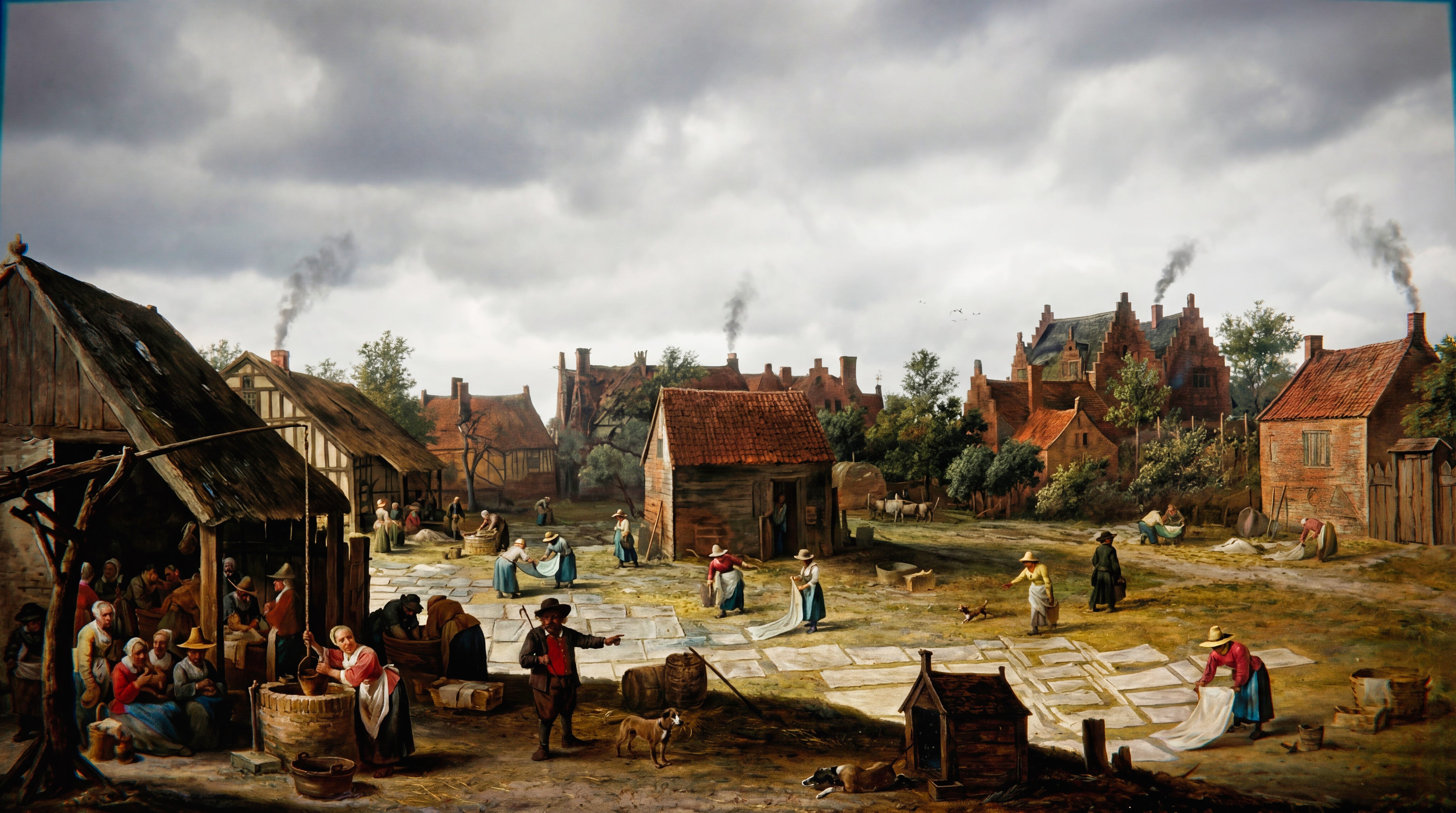
Ravensway was a cloth village. It’s crofting field, where cloth lay bleaching in the sun, was at the edge of Ravensway, and it was the busiest ground in the parish. Long bolts of cloth lay pegged across the grass in pale wet rectangles, so many that from the lane the field looked half-paved with linen. At the well under its timber hood a woman hauled up a bucket and passed it to another, who carried it out at arm’s length, water slopping against her skirt and poured it on the outstretched cloth to keep it wet. Farther off, three women knelt at the edge of a strip, stretching it flat and pinning the selvage into the turf. Beyond the cloth-lines, past the barrels and the tubs of spent lye, the brick gables of the fuller’s house rose with smoke from three chimneys, and behind those the thatched roofs of the village proper crowded together under a sky that promised rain by noon. A man in a broad hat stood with one arm out, pointing at something that did not please him. It was John Grantham the clothier, Rosemary’s father.
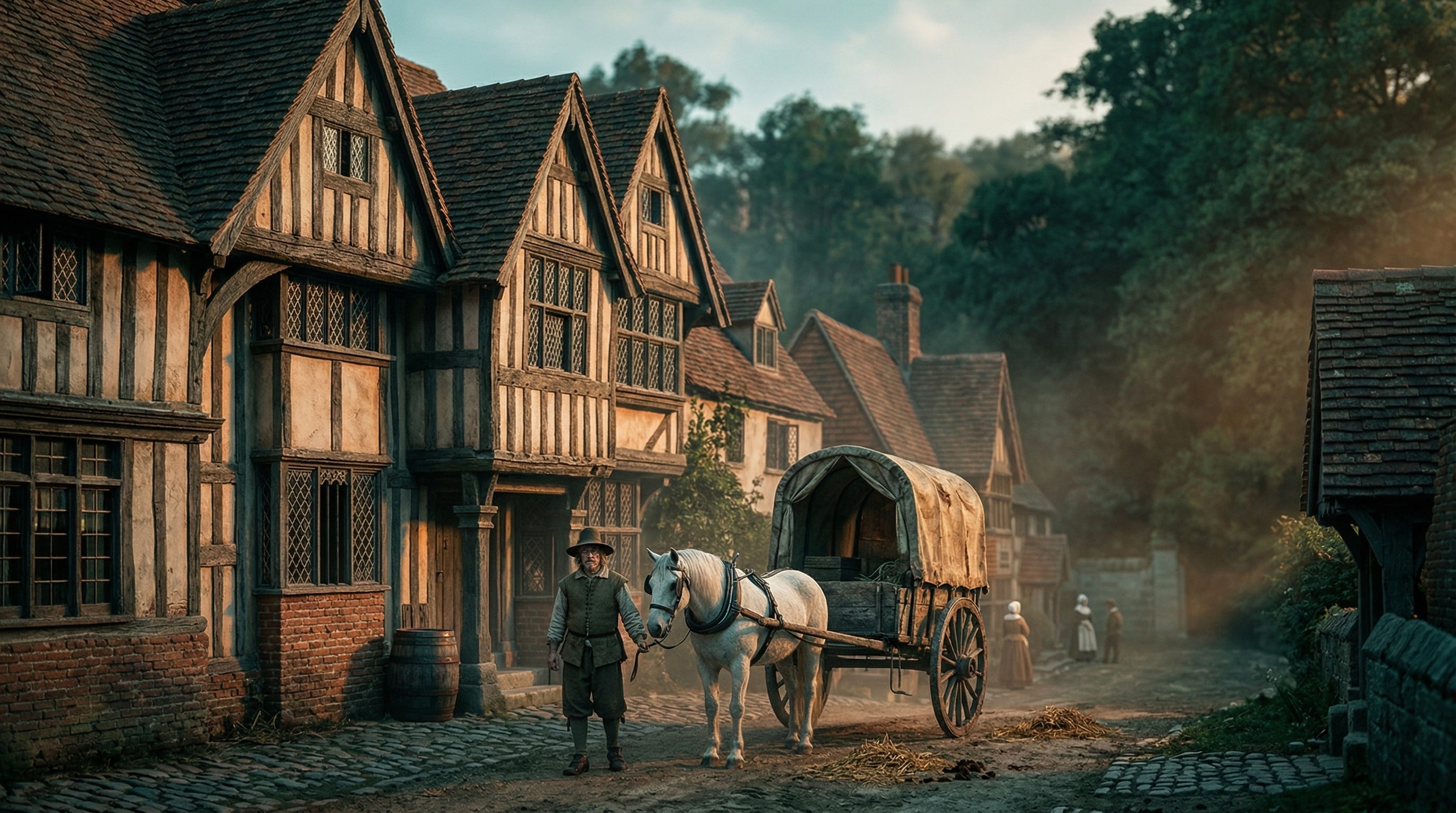
The Grantham house stood flush with a lane in Ravensway, its brick ground course rising from the cobblestones like the base of something meant to last. It was the finest house in the village, and it took care to say so. Where its neighbours' timbers sat on bare stone footings, his rose from courses of good red brick, and the upper storey jutted forward over the street on oak brackets as if the house itself were claiming more of the air than it was owed. The close-set timbers ran in a tight weave no labourer's cottage could afford, and the infill between them was lime-washed white as a new shirt. Its casements were glazed with diamond panes of real glass rather than oiled cloth or window-shuts — four windows across the upper floor alone, each one a small boast. The roof was tile where half the village still made do with thatch. Even the barrel by the door sat upright and clean, as though disorder were a sin that might be catching. Everything about the front of it was a sentence, and the sentence was the same one John Grantham had been saying since he left the loom: we will not fail. We have climbed too far to fail.
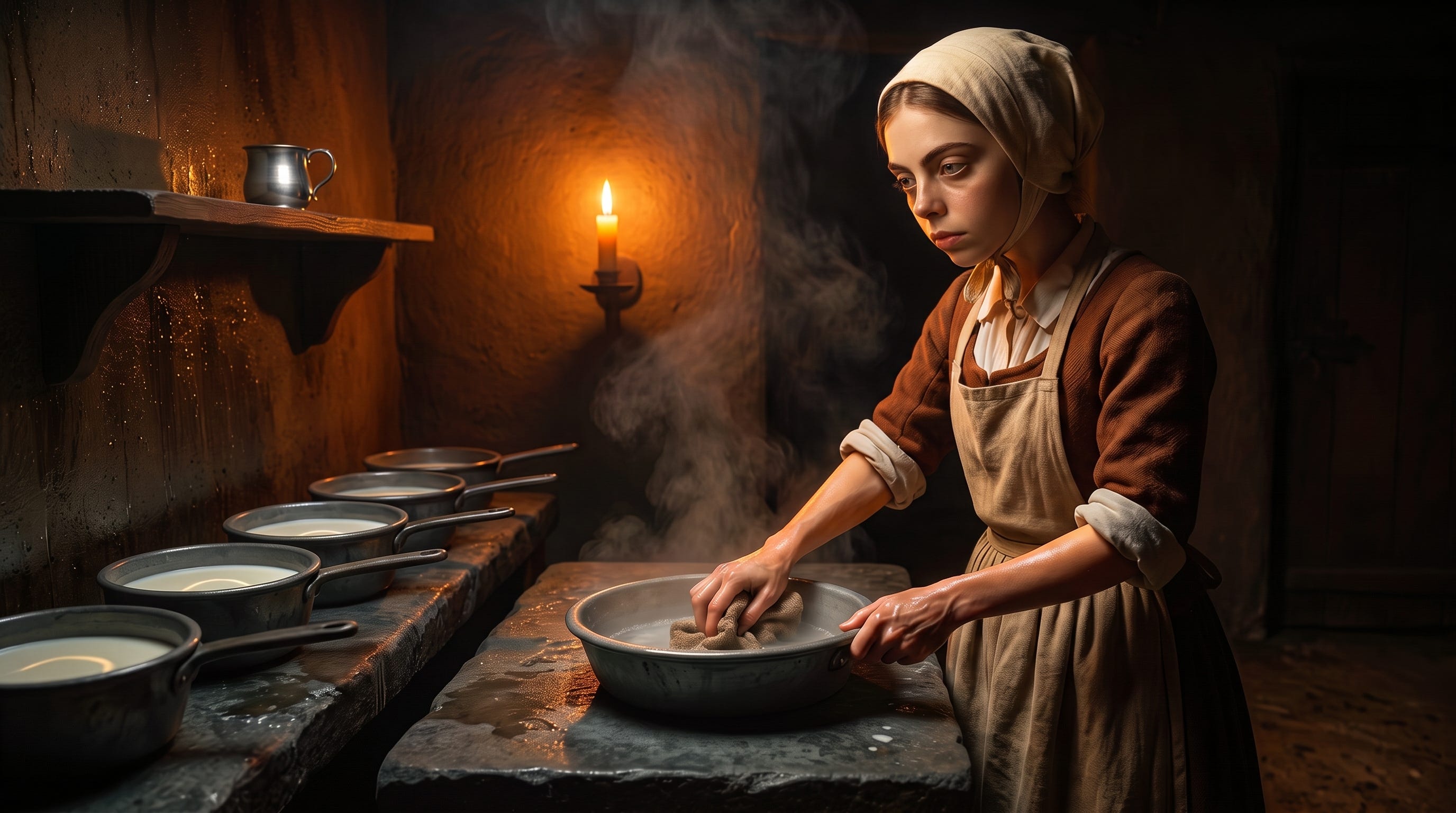
Inside, behind the house, in the cool windowless dairy where the milk was set in shallow pans to rise, Rosemary was working. Sleeves rolled, a coarse canvas apron shielding her brown bodice, Rosemary scoured shallow, lead-glazed pans with scalding water. The windowless earthen room smelled of wet stone, clean milk, and souring cream. Set apart on a shelf gleamed a small pewter cup—the vessel carried to her aunt each morning. Rosemary kept it spotless; the last small mercy she could offer a woman whose own hands were now useless. The light from the doorway shifted. She didn’t need to turn to know her father filled it.

“You’ve your arms in the wash like a servant,” John Grantham said. He blocked the grey daylight from the door. He did not raise his voice; he never had to. He smoothed the front of his fine red broadcloth coat, and the hands that smoothed it were a labourer’s still — thick through the knuckle, the palms ridged and yellow from twenty years of throwing a shuttle, so that the coarse canvas of her apron and the coarse grain of his hands seemed to belong to each other.
“Is that what you learned in Ravidium? I do not keep a daughter who reads three languages so she can do servant’s work.”
“Two,” Rosemary said, plunging another heavy lead-glazed pan into the scalding water. “My Italian is for show.” She wiped her reddened, wet hands on her apron and finally faced him. “It is not a servant’s work I am at, Father. It is the mistress’s. There is a difference.” She lifted her chin a fraction and gave it to him as though reciting in a schoolroom: “— the housewife’s cleanliness in the sweet and neat keeping of the dairy house; where not the least mote of any filth may by any means appear, but all things, either to the eye or the nose, so void of sourness —”
Something in his hard face eased despite him. “That,” he allowed, “is a very pleasant way to describe scrubbing a pan.” And for a moment she thought she had him, thought the old door might open the way it had when she was small and could still make him laugh; but the moment passed, and the merchant came back into his eyes. “Pleasant or no, it is overseeing such work that is the mistress’s part, not the doing of it. You give the order. You keep the standard. You do not carry the hot water yourself.”
“It is Markham,” she said. “The lines I just quoted. Gervase Markham, in his manual “The English Huswife.” Every gentlewoman’s shelf in the parish has it. I am only doing what the book recommends.”
“Then read the book and have the Ashford girl do the scrubbing.” He said it as a merchant closes a ledger. “That is what reading is for. A wife who has read Markham knows when her dairy is ill kept and can say so to a lazy servant. That is worth having. That I’ll grant you, and gladly — use what you’ve learned, every page of it, to manage a great house well.” He looked at the apron, the turned-back sleeves, the reddened hands, and his mouth tightened.
“But you should be out walking, girl, in the air, where you can be seen. Let the parish look at how a lady walks the lane of a fine morning. That is its own kind of keeping, and you neglect it. You spend too many hours indoors over your pages and your pans, and not enough showing Ravensway what my daughter is.”
And there it was, laid out plain: what he wanted her to be, and the narrow shape of it. She heard the whole future in it again, the decorative walking life, and felt the old ache come up under her bright face — the wish that just once he would look at the whole of her and be pleased by what was actually there instead of by what it could be made to fetch. She did not let it show; she had long practice at that. Instead she set down the cloth and changed the subject without warning, because she needed to air the thinking she had done while washing the pans.
“Some have said Aunt Alice is set upon by the devil, others say she had it coming to her, and a few say she has gangrene. That is the most sensible cause of her condition. They say that her flesh has mortified in the bed and that is what has given her palsy. But it is not true, Father. It cannot be. There is no fever in her — I have felt her brow, it is cool as yours. There is no blackening, no foulness, none of the stink that comes off mortified flesh —” Rosemary stepped forward, slapping her damp cloth against the wet stone trough. “Whatever has happened to her, it is not that. Every part of the story is wrong, and I can tell you exactly which part and why”.
For a heartbeat he said nothing. It was not the pause of a man searching for words, but the pause of a man who has just done a sum at speed and hates the total. His calloused knuckles whitened against the doorframe as he looked away from his daughter’s piercing gaze, his eyes fixing instead on the pale milk in the shallow pans. And then, instead of going further, he reached for the easy door. “So you are a midwife now?” He let that land. “And what book is this physics from?” he said. “The smell of mortified flesh from the doorway. The climbing and the not-climbing. What language is this for a lady? Who taught you that, eh? Mother Bunch?” His voice had dropped, and the dropping was the dangerous thing in him. “I will tell you what your aunt is now, Rosemary, since you will hear it from the whole village if you do not hear it from me. Alice Gray is called a cunning woman. A witch, when the speaker is bolder. She engages in the kind of physics that when it fails will bring her to the assizes.”
He picked up a pan and examined it. “She was born a gentleman’s daughter — my own wife’s sister, your blood — and she has come down, down, all the way down to a small stone cottage and no servants.” He moved a pail, avoiding her. “These things you read will be your ruin,” he said. “I have watched them ruin her. I will not watch them ruin you. You will put the cleverness away where it cannot be seen, and you will walk in the air, and you will be what I have spent my whole life making it possible for you to be. I did not climb out of the dirt with these hands so my only child could reason herself back down into it.”
His words went into her like a knife. Under the anger, she could hear the fear—an old warning that had long since forgotten how to sound like love. She did not let her face break. She let nothing into her eyes but a level, burning steadiness, the look of a woman who had heard every word and bent to none of it.
For a moment they stood so, the merchant and his unbending daughter, in the cool dark of the dairy with the milk standing pale in its pans between them. Then John Grantham, who could face a creditor, a bad season, a falling price, and never blink, found he could not go on facing that steady look in his own child’s eyes — and he turned, and walked away, receding into the house, leaving her with the cooling pans and the unanswered question and the old ache she did not let reach her face until the doorway was empty and there was no one left to see it.
She told herself the look on his face had been only the old quarrel, the cleverness he could not forgive her. She had read him her whole life and was seldom wrong. She did not yet know that this was one of the times.
⁂
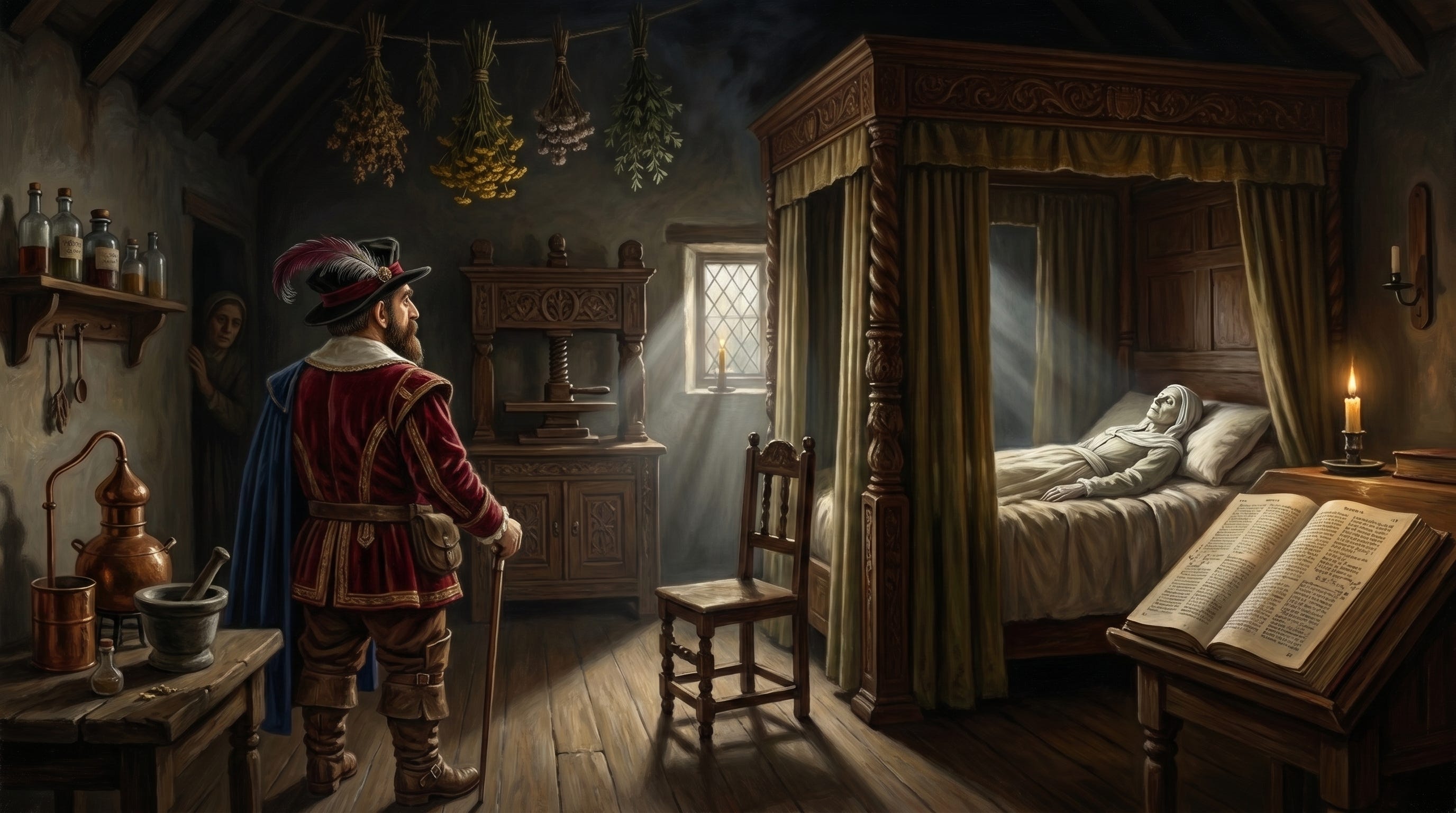
Alice’s cottage staged two conflicting lives: gentleman’s daughter and village cunning woman. A hard wedge of light chiselled the heavy oak press, a turned chair, and a carved tester bed out of the gloom. Shadow swallowed the rest. Bunches of tansy and rue hung from unseen rafters, smelling of dusty funeral wreaths and masking the damp stone. A long board groaned under a row of stoppered glass. Beside a mortar sat a still for distilling waters. Propped open on a slope-topped reading desk, was the great, heavily annotated Gerard’s Herball. It sat there like a loaded weapon; in Ravensway, a cunning woman was only one failed cure away from being dragged in front of the magistrate. Mistress Gray was in the fine bed too good for the walls, stretched out like an alabaster effigy.
The cottage had visitors that day — the parson’s satchel set down on the press and forgotten on his leaving, the constable moving soft along the wall. At the foot of the fine bed stood a gentleman, dressed in a well-cut doublet of dark, good cloth and soft leather boots. The cloth was good and the cut was better, though the lace at one cuff had been re-pointed by hand, which was taken as a sign he was a man of good thrift. He was watching the door. When Rosemary came through it, he broke into a huge smile. Sir Arthur Radclyffe stared at the alabaster figure and whispered, ‘gangrene.’
Rosemary ignored the diagnosis. There was no fever, no foulness, no blackening, none of the corruption she knew from her books.
There was only a woman gone still as alabaster, her eyes alone alive in her face, and those eyes fixed on her niece with an intensity that unnerved her.
